
Scan the QR code on the vending machine, select the “Anxiety Relief” option, and three minutes later, a cute anxiety-emoji-shaped treat pops out. Take a bite—it’s a delicious chocolatey delight.
The seemingly sophisticated 3D printing technology is actually right at our fingertips. Today’s 3D printers can not only produce handicrafts and toys, but also cross over into the food industry, enabling fully automated printing of your very own “Anxiety Relief” treats.
As Founder, Chairman and CEO of Hangzhou Pandar Technology Co., Ltd., post-90s entrepreneur Li Jingyuan has spent nine years working with his team to bring 3D printers into every corner of daily life, starting from Hangzhou.
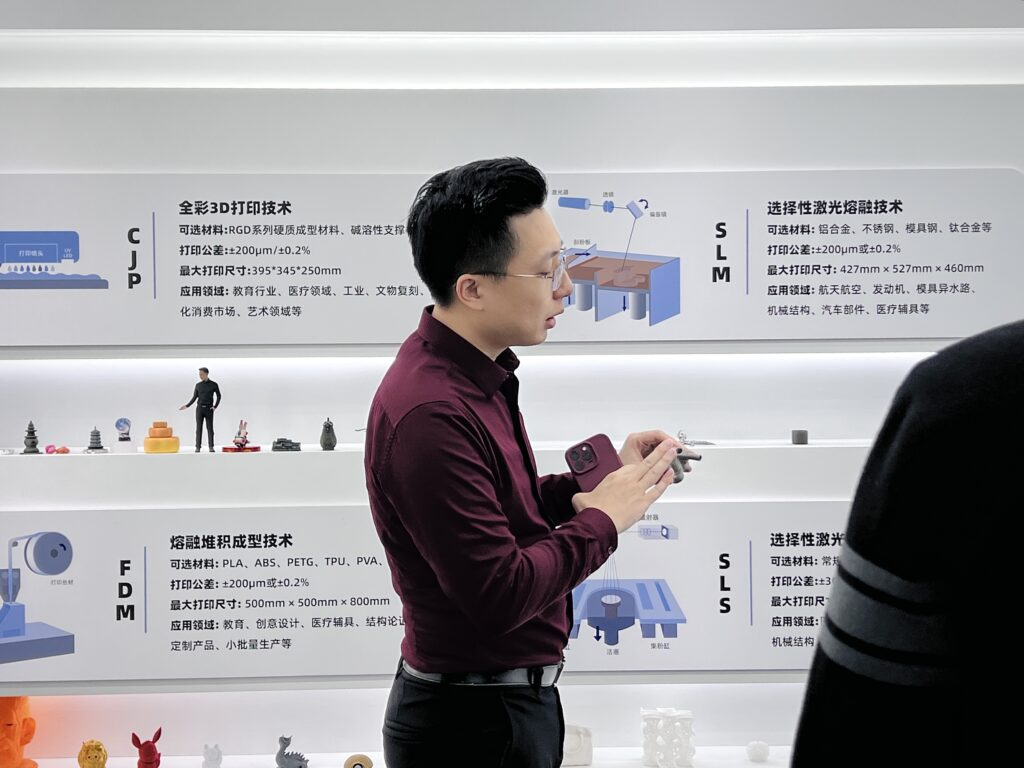
Printing Chocolate, Toys and Even Seals
“3D printing was originally more focused on industrial applications, but us young people always want to explore more possibilities,” Li said. A native of Shanghai, he was admitted to Zhejiang University without taking the college entrance exam in 2011, where he majored in industrial design. Thanks to his academic background, he became one of the first people in China to get hands-on experience with 3D printing equipment.
Li explained that 3D printing boasts great flexibility, which inspired him to apply this technology to daily necessities related to “clothing, food, housing and transportation”—especially food 3D printing.
It sounds simple enough, but there were certainly hurdles to overcome.
R&D began in 2014, and it took a full two years before Li launched his first device.
Li noted that the core technologies of 3D printers mainly include hardware, software and materials. When it comes to materials, he experimented with hundreds of ingredients before finalizing more than 20 options, including cookies and purple sweet potatoes. Among them, chocolate proved to be the most popular choice, thanks to its good stability, moldability and long shelf life.
However, unlike regular chocolate, the chocolate material used in 3D printers requires special customization.
“We jointly developed it with Tianshun Group, Asia’s largest chocolate manufacturer. Together we built a production line with custom-formulated oils and cocoa,” Li said.

In 2018, Pandar launched China’s first self-service 3D dessert vending machine, positioning it as an innovative, tech-driven experiential product. Targeting shopping malls, cinemas and amusement parks, the machine offers an online DIY interactive function for customers to create custom food shapes, with personalized treats ready in just a few minutes. Leveraging 3D printing, artificial intelligence and big data technologies, it integrates IPs with chocolate to deliver trendy, customized food products for consumers.
A great product speaks for itself in the market.
Li’s creation gained nationwide attention, making appearances on CCTV and even at the Asian Games. During last year’s Hangzhou Asian Games, the chocolate 3D self-service printer became a hit in the Athletes’ Village. Many athletes printed 3D chocolate replicas of themselves and Hangzhou’s landmarks—produced in real time, the experience was incredibly immersive and left everyone pleasantly surprised.
This success further strengthened Li’s confidence. By combining new technologies with market validation and iterative improvements based on feedback, he aims to bring unique experiences to more cultural and tourism scenarios.
Li revealed that a new device has recently been installed at the Xiling Seal Art Society, capable of printing customized seals.
What It’s Like to Have 9,998 WeChat Friends
“Creating value for society, and making friends along the way.” This has long been the signature line on Li’s WeChat profile. He believes that the ideal state of entrepreneurship is to apply cutting-edge technology to daily life, bringing experiences and joy to consumers.
Throughout his entrepreneurial journey, Li has kept pace with the tides of the times, driving his business forward with boundless energy. “The entrepreneurial atmosphere in Hangzhou is amazing—everyone works hard together,” he said.
Li loves making friends, and his WeChat friends list has long been full. “It’s because I’m in Hangzhou that I’ve had the chance to meet so many like-minded friends—9,998 in total. Look, this is the boss of the company next door I met at a park dinner after moving into Cainiao Smart Valley. Later, I found out he’s also a friend of my teacher. Exchanging ideas with each other helps us avoid detours.”
In the inclusive city of Hangzhou, countless tech startups have taken root and flourished. Recently, as his team grew, Li moved his company to Cainiao Smart Valley Industrial Park. “The location is excellent, and the park offers a complete ecosystem and supporting facilities. We can take care of everything—from having tea and meals to holding meetings—without even leaving the park.”
Most importantly, “it feels like home here, warm and welcoming,” Li explained. The property management team communicates efficiently and amicably, and also provides free assistance for enterprises to connect with local government authorities, helping them secure various policy incentives.
Naturally, the various on-site events held in the park also attract Li. “I’ve always believed that communication sparks inspiration.”

Seeking More Entrepreneurial Partners in Hangzhou
After nine years of entrepreneurship, Li’s biggest takeaway is the importance of perseverance. “Jokingly, I call this blind confidence,” he said.
Li has observed that people who frequently switch business tracks have a relatively low success rate. Only by sticking to one field for the long term can a business build up barriers to competition and thrive in the commercial landscape.
To date, Pandar has deployed over 3,000 offline 3D printing devices, covering nearly 70% of China’s provinces, with applications in scenic spots, cinemas, shopping malls, museums and other scenarios. In the professional research field, more than 300 academic and research institutions are using Pandar’s products. Additionally, the company’s equipment has been exported to 25 countries and regions.
“We’ve maintained our position as the market leader in China, reaching a scale of 100 million yuan in 2024,” Li said. According to his plan, in the short term, he aims to expand the business significantly—growing the number of devices from 3,000 to 30,000. In the long run, while currently serving 10,000 users a day, he hopes to cater to 100 million users in the future.
“Rooted in Hangzhou, going global.” Though this slogan sounds ambitious, it’s more than just empty words. Li explained that for Pandar, foreign trade is a key strategic pillar, and the company must embrace an international perspective. “The global market is vast enough. We hope to connect with more partners for overseas expansion, and together—starting from Hangzhou—we can serve channel partners, suppliers and consumers around the world,” Li said.
As a new resident of Hangzhou, Li told reporters that through his interactions with local entrepreneurs, he has learned a great deal from the older generation of Zhejiang merchants. “They are fully dedicated to their work and stay true to their entrepreneurial aspirations. What’s more, they are very warm-hearted—it’s not just cold business transactions. They are willing to nurture young people, guiding and investing in us.”